
Hermann shaped Fulda as an entrepreneur and founding member of the Rhön Club.
Born on July 17, 1840 in Fulda.
Hermann Jacobson had a lasting impact on the cultural and economic life of his hometown. As a founding member of the Rhön Club in 1886 and long-time treasurer and honorary member, he dedicated himself wholeheartedly to the promotion of the region. He had already been involved with the Fulda Natural History Society since November 1865, and its mission was always close to his heart.
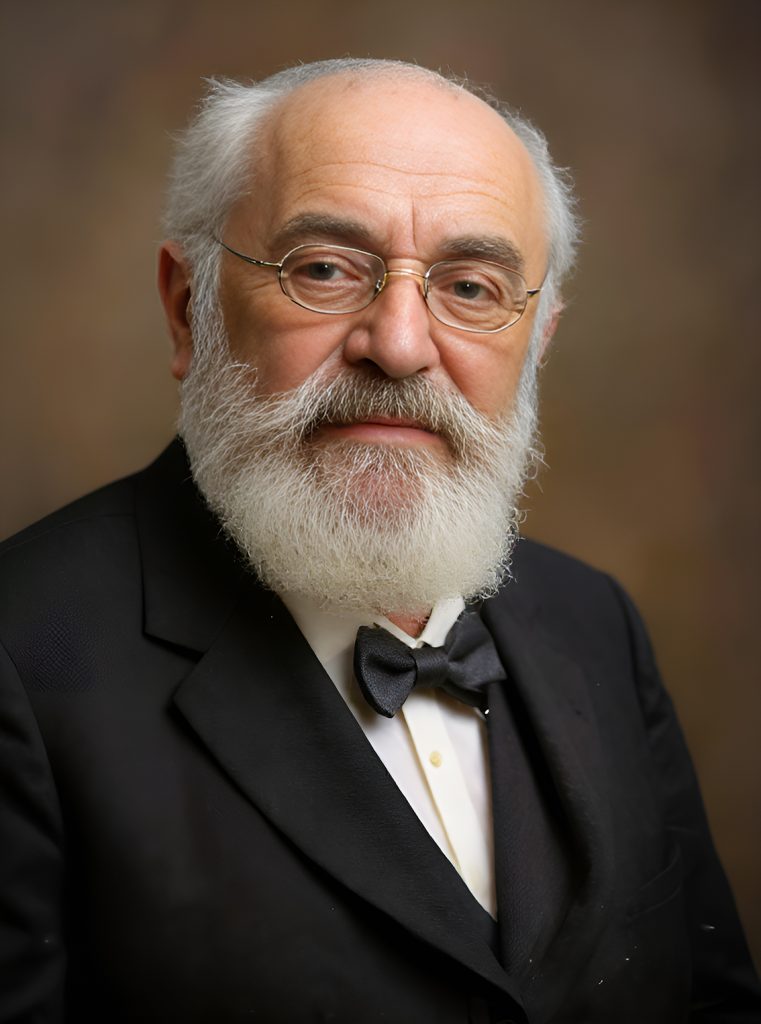
Entrepreneurial advancement
From the home weaving business of his father Justus Jacobson, who founded the weaving mill in Fulda in 1827, Hermann, together with his brother Isfrid, developed the mechanical linen, damask and patterned weaving mill at Langebrückenstraße 44. With astute entrepreneurial spirit and tireless dedication, he contributed to the flourishing of the local industry.
Social and cultural engagement
Beyond his economic achievements, Hermann was a passionate promoter of social, musical, and touristic life in Fulda. His commitment ignited a sense of community and enriched the city in a lasting way.
Hermann Jacobson died of a stroke on March 28, 1920. The funeral took place in Wiesbaden.
Addresses in Fulda:
Home address: Buttermarkt 2
Business address: Langenbrückenstr. 44/46
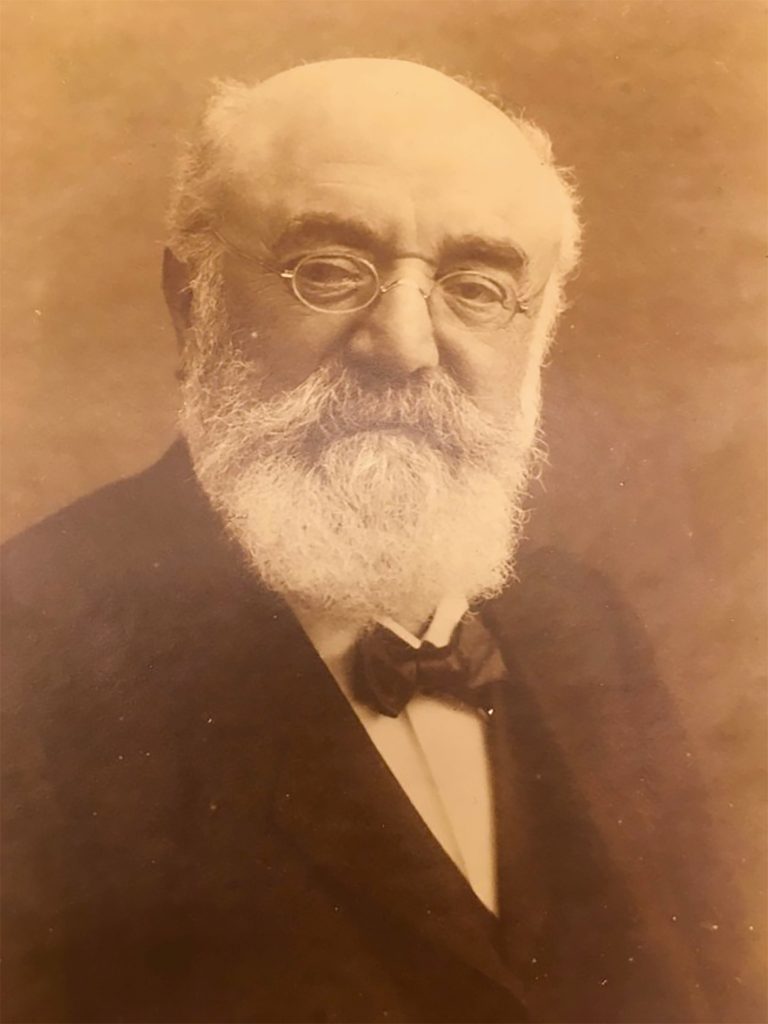
Based on the original photograph shown, all depictions have been reconstructed using artificial intelligence.
A family business with a century-long tradition
Hermann Jacobson was born in Fulda in 1840 and came from a family with deep roots in the town. His father, Justus Jacobson, had founded the firm J. Jacobson – a mechanical weaving mill specialising in linen fabrics – as early as 1827. Over time, this small workshop developed into a major enterprise, which celebrated its centenary on 1 January 1927. This anniversary symbolises consistency, innovative strength and economic success in the region.
Innovation and quality in textile production
The company specialised in high-quality linen and damask fabrics, which were produced by local weavers. It was particularly renowned for its finest table linen and towels with woven-in names – a speciality of the house since the 1870s. The company received numerous awards at international exhibitions, such as those in Amsterdam and Metz, which underscored its outstanding quality.
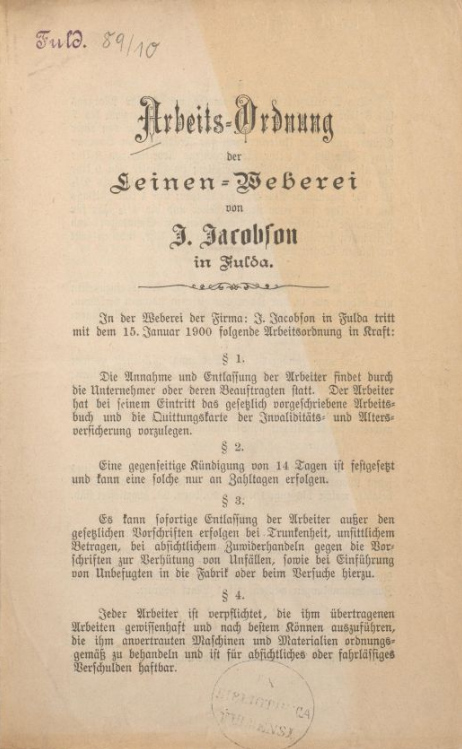
Company Rules and Regulations, 1900
Economic success and social commitment
Jacob Jacobson, the company’s founder, took a significant step towards transforming the regional textile industry: he was the first in Fulda to introduce the weaving of bleached linen yarn. This technical innovation brought a fresh impetus and marked the transition from traditional hand weaving to modern machine production. The company supported local weavers by supplying them with yarns and by promoting the quality and design of their fabrics. An in-house dyeing facility ensured that the latest colours were always available – in line with market demands.
Im Laufe der Jahrzehnte wuchs J. Jacobson zu einem führenden Hersteller hochwertiger Textilien heran – getragen von einer soliden Geschäftsführung und großem Innovationsgeist. Hermann Jacobson starb 1920; sein Sohn Isfried setzte die Familientradition fort und leitete das Unternehmen bis zur Zwangsversteigerung im Jahr 1934.
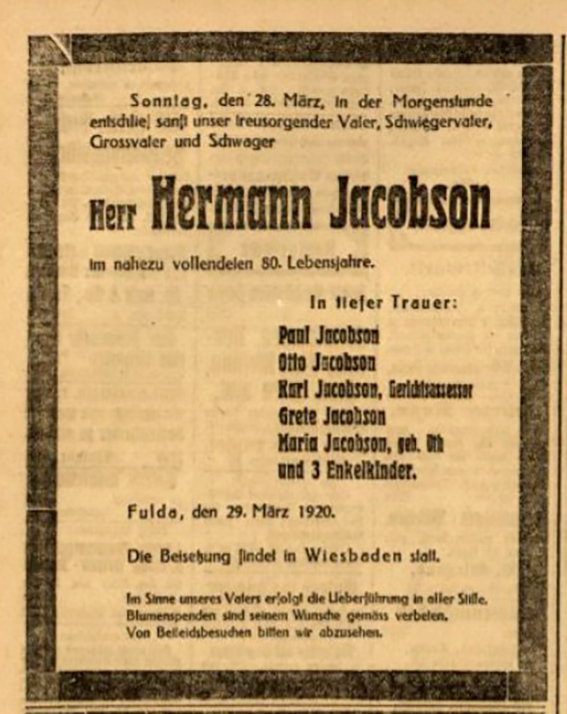
Obituary of Hermann Jacobson, 1920
Founding member of the Rhön Club Fulda
In addition to their economic success, the owners were also deeply involved in the community. Particular mention should be made of Hermann Jacobson’s role as a founding member of the Fulda Rhön Club. Since 1876, the Rhönklub has been committed to promoting the Rhön as an attractive destination and making it accessible to everyone. Its aim is to enhance the natural environment and the tourist infrastructure of the mountains – so that every visit becomes a special experience.
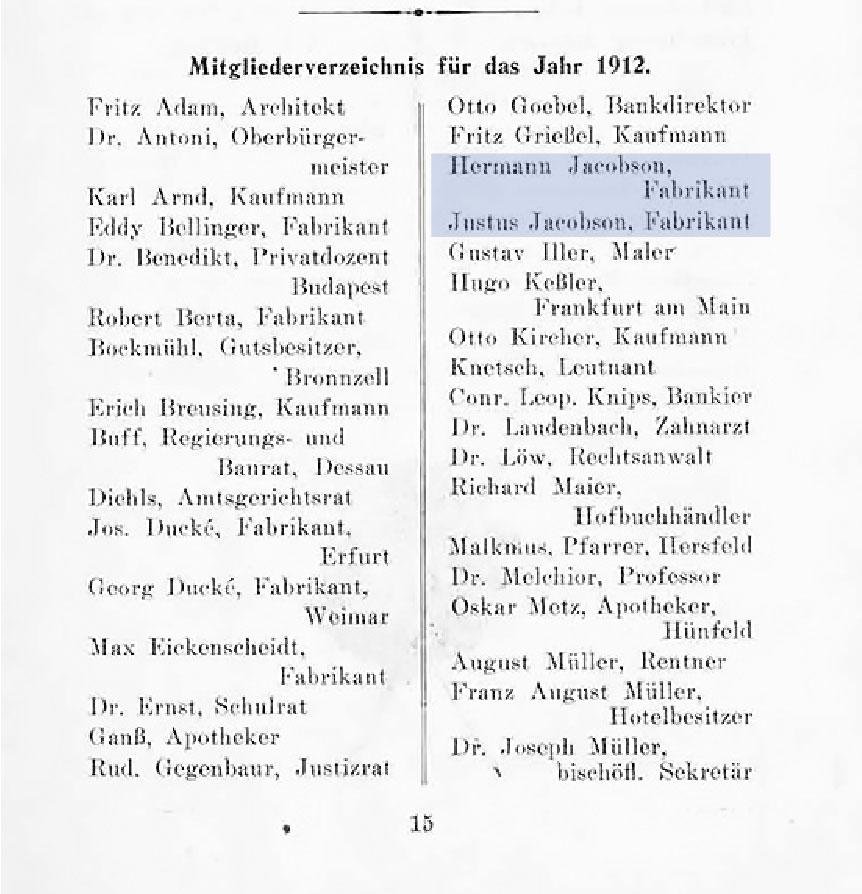
Rhön Club Membership Directory, 1911